
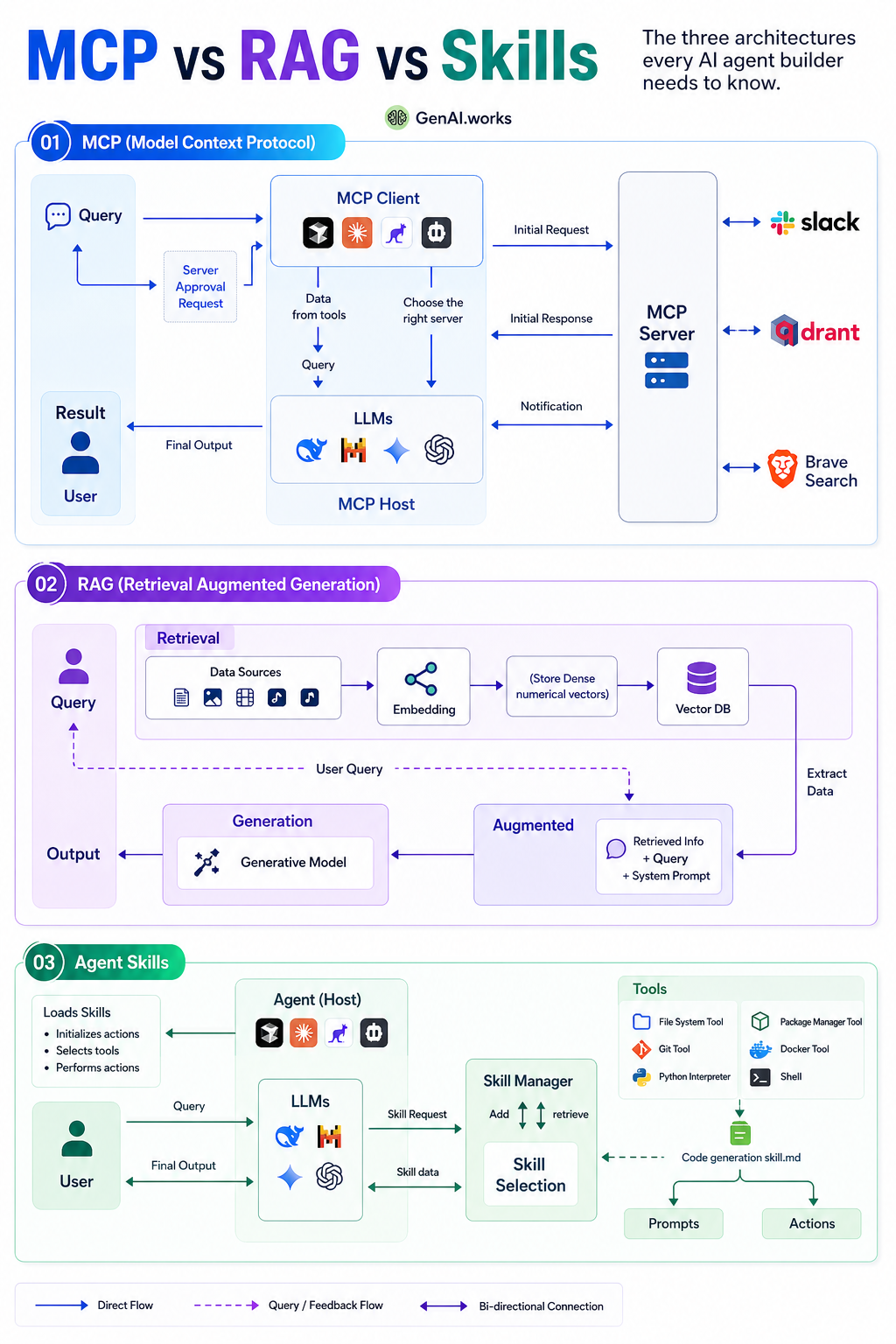
Most people treat MCP, RAG, and Skills as competing choices. They are not. They are three layers of the same agent stack.
“Should I use MCP or RAG or Skills?” — use each where it belongs: connect, know, and act.
MCP
Model Context Protocol gives the model a standard way to talk to tools, APIs, Slack, and databases.
- Route a request to the right system
- Fetch data or perform an action
- Return the result to the model
RAG
Retrieval-Augmented Generation grounds answers in your docs, PDFs, and live knowledge — not only training data.
- Embed and store your corpus
- Retrieve relevant chunks per query
- Pass context + question to the model
Skills
Skills package repeatable procedures — the playbooks your agent should follow when a job shows up more than once.
- Encode workflows and guardrails
- Reuse proven steps across agents
- Keep behavior consistent as tools change
MCP connects. RAG provides knowledge. Skills turn both into reliable work.
When to use each
Reach for MCP
When the agent must touch real systems — tickets, CRM, databases, calendars — without a one-off integration for every tool.
Reach for RAG
When answers must reflect your private or changing knowledge: policies, product docs, reports, or support history.
Reach for Skills
When the same multi-step job repeats and you need a durable procedure instead of prompting from scratch each time.
How they fit together
A strong agent usually needs more than one layer. MCP opens the door to systems. RAG fills the room with the right facts. Skills decide the sequence of moves once the facts and tools are available.
User ask
  → Skills pick the playbook
  → RAG loads the facts that matter
  → MCP calls the tools the playbook needs
→ Model responds with grounded, actionable outputBuying another “brain” when the real gap is connection (MCP), knowledge (RAG), or procedure (Skills). Diagnose the layer before you add another model.
Bottom line
Stop forcing a single winner. Design the stack: connect with MCP, ground with RAG, and operationalize with Skills. That is how agents stay useful past the demo.